


Subscribe
Stay in the know
Discover the latest payments news and events from Yaspa and the fintech world in our monthly newsletter.

Open banking payments promise speed, simplicity and certainty. But in practice, certainty is often the one thing merchants don’t get.
At Yaspa, we obsess over payment reliability. Every Pay by Bank transaction is treated with forensic attention to make sure it arrives where it should – quickly, securely and fully reconciled. That focus has led us to rethink how payment outcomes should be determined in open banking, and why the industry’s current approach often falls short.
The result is a fundamentally different way of interpreting payment status – one that delivers predictable outcomes for merchants, even when banks behave unpredictably.
While open banking is often spoken about as a single standard, the reality is far more fragmented. Every bank implements payment flows and status updates differently. That means the experience of a Pay by Bank transaction can vary significantly depending on the customer’s bank and geography.
Behind every open banking payment is a journey through multiple stages. Funds are initiated, assessed, accepted by the bank and eventually settled. These stages are communicated using ISO status codes, but there is no universal agreement on how or when those codes should be used.
For merchants, this creates a critical problem: a payment can appear “successful” long before it is genuinely secure.
Payment status at any moment in time is determined by ISO codes sent by banks. Some banks treat early-stage checks as confirmation. Others only signal acceptance at the very end of the process.
This inconsistency creates risk. Merchants may release goods or services based on a status that later proves unreliable, only to find that funds never arrive or the payment is ultimately rejected. In high-risk environments like iGaming, this opens the door to abuse, fraud and operational headaches.
The challenge is made worse when open banking providers rely on surface-level status checks that lack context or depth. Without understanding how individual banks apply and sequence ISO codes, status updates can give a misleading sense of certainty.
Many open banking providers still rely on polling to track payment status – repeatedly querying bank APIs to check whether anything has changed. On the surface, this seems sufficient. In reality, it’s one of the biggest reasons merchants still experience unreliable payment outcomes.
Polling introduces delay by design. Status checks happen at fixed intervals, meaning critical changes can be missed or detected too late. More importantly, polling treats all banks the same. It assumes that a status update means the same thing regardless of where it comes from, when in fact the same ISO code can signal very different levels of certainty depending on the bank issuing it.
This approach creates a false sense of confidence. A payment may appear stable simply because nothing has changed since the last poll, not because it is genuinely secure. When combined with inconsistent ISO implementations, polling masks risk rather than managing it.
Real-time payments require real-time intelligence. Without event-driven notifications and bank-aware logic, polling will always lag behind what is actually happening inside the banking network. For merchants operating at scale or in regulated environments, that lag is no longer acceptable.
At Yaspa, we believe reliable payments require more than periodic status checks. That’s why we built our own payment status and notification logic in-house.
Instead of polling, we operate a real-time, event-driven status-notification engine that monitors transactions at every stage of their journey. We analyse how each bank behaves, how their ISO codes are applied and how those patterns evolve over time.
Every transaction is tracked across up to 15 distinct statuses, from initiation through to completion. Merchants receive real-time webhook updates as payments progress, with outcomes only confirmed when we are confident funds have genuinely settled – or will.
Crucially, this allows us to spot issues instantly. If a bank drifts from expected behaviour, we know immediately and can adjust configurations to protect both conversion and security.
Bringing payment intelligence in-house gives Yaspa something most open banking payment providers lack: control.
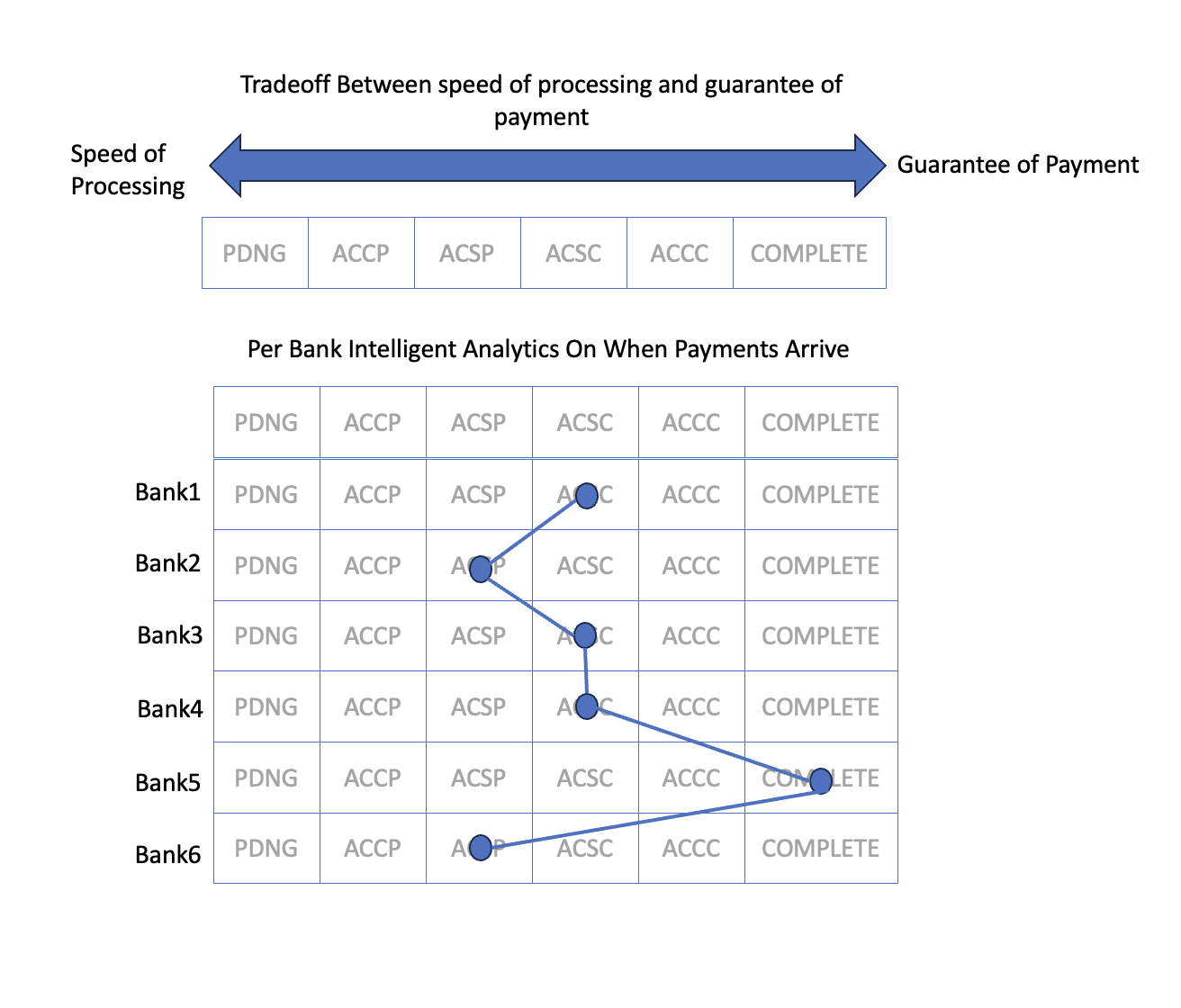
Rather than treating all banks the same, we apply per-bank logic when interpreting ISO codes. We decide what constitutes an ‘Accepted’, ‘Rejected’ or ‘Cancelled’ outcome based on the specific bank a customer uses.
Some banks, such as Revolut, require a transaction to pass through every possible status before acceptance can be trusted. Others provide reliable signals much earlier. By applying this logic dynamically, we ensure merchants are never told a payment is accepted before it is.
This level of precision simply isn’t possible when relying on third-party status aggregation.
The diagram below illustrates how different banks interpret and sequence ISO codes on the journey to an ‘Accepted’ payment – and why bank-specific logic is critical to delivering reliable, consistent payment outcomes.
Payment status is often treated as a binary signal: successful or failed. In practice, it is neither.
Regulators and operators tend to focus on compliance with open banking standards, assuming that adherence to those standards guarantees consistent outcomes. In reality, standards define formats, not behaviour. They specify how banks should communicate status updates, but not when those updates should be sent or how much confidence they should convey.
Two banks can be fully compliant and still interpret the same payment journey in entirely different ways. One may signal acceptance early to optimise user experience. Another may delay confirmation until every internal check has completed. Without deeper context, both signals appear equally valid.
For operators, this blind spot is often introduced by the technology layer they rely on. Providers that do not interpret payment status at a system level, or that treat all bank signals as equal, can inadvertently push operators towards overly cautious controls or increased risk exposure. For example, treating a payment as accepted too early may allow play to begin before affordability checks are complete, exposing operators to regulatory and financial risk if the transaction is later rejected.
The next stage of open banking maturity requires moving beyond compliance and towards interpretation.
Because we understand how individual banks behave, we can often foresee a payment’s outcome before funds physically land in a merchant’s account.
Rather than forcing merchants or customers to wait minutes or even days for settlement, we deliver instant, trustworthy payment outcomes without compromising on certainty.. That means goods and services can be released without delay, improving customer experience while still maintaining robust risk controls.
It’s a key step towards delivering on the original promise of open banking payments.
This intelligence doesn’t just benefit merchants – it improves the payer experience too.
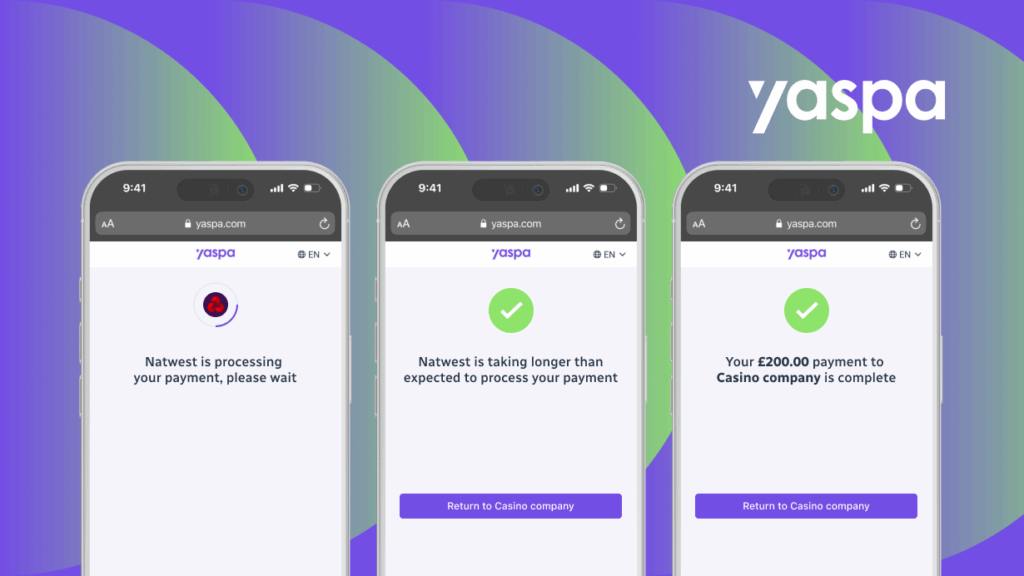
As a payment progresses, users see simple, transparent wait screens that confirm checks are underway. If a payment takes longer than 60 seconds, they’re clearly told their bank is still processing it and redirected back to the merchant’s site, without friction or uncertainty.
Payments continue in the background, keeping the experience calm, honest and uninterrupted.
For merchants, reliable payment outcomes translate directly into performance.
Since implementing this approach, Yaspa has delivered measurable improvements across conversion, speed and security:
Very few open banking payment providers handle payment status logic themselves. Even fewer do it with this level of depth.
At Yaspa, we believe payments should be fast, secure and predictable – every time. By rethinking how payment outcomes are determined, we’re not just improving Pay by Bank for our merchants, but raising the standard for the industry as a whole.If you’d like to see how this approach could work for your business, get in touch with our team.
Subscribe
Discover the latest payments news and events from Yaspa and the fintech world in our monthly newsletter.
"*" indicates required fields