

Subscribe
Stay in the know
Discover the latest payments news and events from Yaspa and the fintech world in our monthly newsletter.

I’ve spent my career working at the intersection of gaming operations, audit, corporate development, and partnerships at Caesars, Amazon, and Sightline Payments. Across each of those roles, the most important question was never whether a new product would work. It was whether the environment around it was ready to support the people using it.
That question is now front and centre for prediction markets.
This is a space moving at extraordinary speed, already capturing billions in volume, attracting mainstream consumers, and blurring the lines between financial investment, sports wagering, and everyday entertainment.
Prediction markets are scaling like consumer products, but they’re still largely governed like institutional financial tools. That mismatch is where the real risk sits.
The legal battles playing out across state courts, federal appeals circuits, and Congress are significant. But underneath all of it is a more fundamental challenge: this consumer-facing product is scaling faster than the frameworks designed to protect the people using it.
My goal here isn’t to argue whether prediction markets are inherently good or bad, or where they should sit jurisdictionally. Innovation matters. Growth matters. But growth without the right guardrails doesn’t serve consumers – and ultimately, it doesn’t serve the industry either.
One of the most immediate challenges in this space is definitional.
Ask ten users what prediction markets are, and you’ll get ten different answers: a financial tool, a forecasting mechanism, a sports betting platform, or simply entertainment. The reality is that they are all of these things at once – and that ambiguity is exactly the problem.
By early 2026, roughly 90% of volume on leading platforms was tied to sporting events. These are consumers staking money on game outcomes, player performance, and live sports action.
Some arrive expecting the disclosures and protections of financial products. Others expect the safeguards of regulated sports betting. Many are new to both, drawn in by intuitive apps and viral social content.
When a product serves multiple audiences without clearly defining what it is, what protections apply, and what risks exist, the consumer is the one left exposed.
A well-functioning market starts with clarity: what is this product, who is it for, and what does a user need to understand before engaging?
State gaming frameworks, for all their complexity, are built on a clear principle: consumers engaging with wagering products deserve baseline protections. That includes fair odds, dispute resolution, identity verification, responsible gaming tools, and access to support resources.
The federal commodities framework currently governing prediction markets was designed for institutional derivatives markets. It does that well. But a consumer-facing product built around real-time, event-driven participation is a different challenge entirely.
Protecting retail users engaging with sports-linked outcomes requires safeguards the gaming industry has spent decades developing. That’s the gap – and it’s increasingly visible.
Today, consumers on these platforms may have limited recourse if something goes wrong. They may lack effective self-exclusion tools. They may not receive clear disclosures that help them understand the nature of the risk they’re taking.
This is where modern infrastructure can play a meaningful role.
Real-time identity verification, account-to-account (A2A) payments, and access to financial data already exist in adjacent sectors. Applied correctly, these tools can help platforms better understand who their users are, assess risk earlier, and create safer, more transparent experiences.
What’s changing now is not just access to these capabilities, but how they’re applied. The next phase of infrastructure is about moving from static checks to real-time decisioning – combining financial data, behavioural signals, and identity insights to detect risk earlier and respond dynamically.
That shift matters. It moves platforms from reacting to harm after it occurs, to identifying and mitigating risk as it emerges.
Some operators are taking meaningful steps to address the consumer protection gap. IC360, global compliance technology and advisory platform, has partnered with prediction market platforms to introduce prohibited participant controls and cross-platform self-exclusion – infrastructure that regulated sports betting has relied on for years.
That kind of industry initiative matters. It signals a growing recognition that consumer protection and platform growth are not competing priorities.
But voluntary action, however well-intentioned, isn’t a substitute for a consistent regulatory baseline.
Effective protection starts with understanding who is actually using these platforms.
There are sophisticated traders approaching event contracts as financial instruments. There are sports bettors seeking markets unavailable through licensed sportsbooks. There are casual users arriving via social media with limited understanding of pricing or platform mechanics.
Each group carries different expectations, risk levels, and vulnerabilities. Treating them as a single audience inevitably leaves gaps.
Technology can help close that gap – not by restricting access, but by enabling more intelligent, real-time responses. When platforms better understand a user’s financial context and behaviour, they’re in a stronger position to tailor safeguards, surface relevant information, and intervene when risk signals emerge.
There’s no single policy fix, but there are clear steps that would materially improve the consumer environment.
1. Clear, plain-language disclosure
Consumers need to understand what they’re using before they fund an account – how it works, how the platform makes money, and what risks are involved.
2. Cross-platform self-exclusion
Self-exclusion limited to a single platform isn’t effective. A baseline, interoperable approach is essential.
3. Stronger controls on insider participation
Event-based markets carry inherent risks of information asymmetry. Prohibited participant frameworks need to be mandatory and actively enforced.
4. Smarter, data-driven safeguards
As platforms gain access to richer financial and behavioural data, there is an opportunity – and responsibility – to move beyond static checks and implement dynamic safeguards that adapt to user risk in real time.
Prediction markets represent a real convergence of entertainment, financial participation, and information exchange. The demand is there. The technology is there. And the potential is undeniable.
But so is the risk.
We’ve seen this pattern before – in early online gaming, in the first wave of mobile sports betting, and in fintech products that blurred the line between banking and gambling before clear frameworks existed.
The lesson isn’t to slow innovation. It’s to support it with the right infrastructure.
That infrastructure increasingly exists thanks to open banking – from instant A2A payments to real-time financial insight and identity verification. The opportunity now is to apply it deliberately, building consumer protection into the foundation of these platforms rather than layering it on later.
Markets that scale without consumer protection are fragile. The ones that endure are those that build trust early.
The regulatory debate will continue to play out across courts and Congress. But operators don’t need to wait for perfect clarity to act.
The platforms that move early to embed transparency, smarter safeguards, and real-time risk understanding won’t just be better positioned for future regulation – they’ll help define what that regulation looks like.
Because in the long run, success in this market won’t be determined by who innovates fastest.
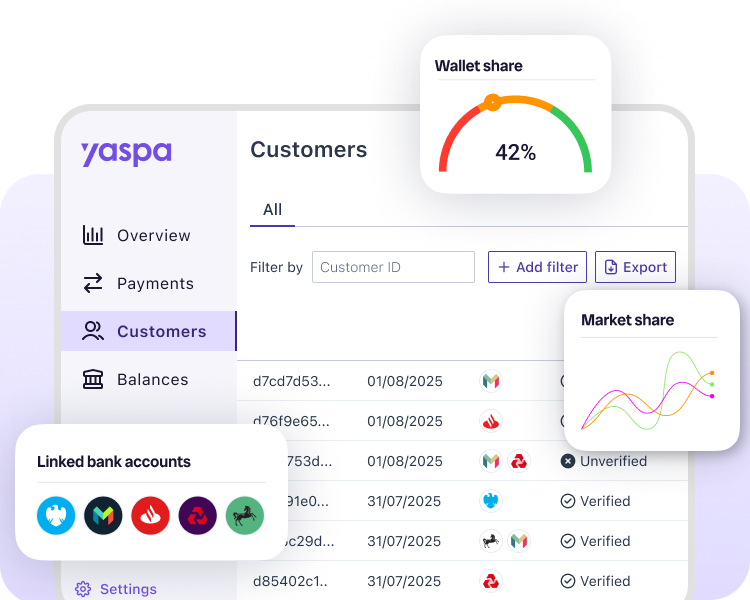
It will be determined by who earns trust first. Solutions like Yaspa’s Intelligent Payments platform are already enabling this shift – combining real-time payments, identity, and financial insight to help operators better understand users and act on risk as it emerges. Get in touch to find out how or to see a demo.

Subscribe
Discover the latest payments news and events from Yaspa and the fintech world in our monthly newsletter.
"*" indicates required fields