

Subscribe
Stay in the know
Discover the latest payments news and events from Yaspa and the fintech world in our monthly newsletter.

Here’s a problem every iGaming operator in the US market recognizes, even if nobody says it out loud: you don’t actually know who your VIPs are until they’ve already been playing for weeks, sometimes months.
By the time deposit history builds up enough to tell a high-value player from a low-value one, you’ve already spent your retention budget treating them the same. The whale and the one-and-done depositor got the identical welcome bonus. One of them was worth chasing. The other wasn’t. You just couldn’t tell which was which on day one.
It’s a widely cited rule of thumb in iGaming that up to 80% of iGaming revenue comes from the top 5% of players. Finding that 5% early isn’t a nice-to-have. It’s the whole game.
And yet the standard playbook is built around waiting. Conventional VIP identification leans on deposit history, and deposit history can take months to reveal anything reliable. So the early lifecycle becomes a blanket exercise: every new player gets broadly the same bonus, the same match, the same treatment, right up until the point their real value can finally be quantified. Which, by definition, is too late to have shaped anything that mattered in those first critical weeks.
This is where Yaspa’s Intelligent Payments changes the timeline. Conventional VIP identification, however sophisticated the model behind it, is still inferring value from behavior. No operator has actually seen a player’s income, their balance, or their real financial exposure—until now. Intelligent Payments replaces that inference with verified data. Using machine learning, it turns a player’s consented bank data into a cohort signal from their very first deposit. One bank connection, at the point of deposit, no added friction, always with the player’s consent.
Out of the box, Yaspa gives operators a suggested three-cohort starting pattern: VIP, recreational, and low-value. On a 100,000-player base, a typical starting split might land around 5% VIP, the bulk recreational, and a smaller low-value tail. From there, the cohorts are yours to shape. Adjust thresholds, add tiers, build it around how your program actually runs.
Cohorts aren’t fixed at first deposit, either. As a player’s behavior shifts, so does their placement. A recreational player who starts showing VIP signals moves up. A VIP whose affordability tightens moves down. Every change flows through a webhook straight into your CRM and bonus engine, so your program is working from this week’s picture of a player, not last month’s.
Running alongside all three cohorts is an affordability signal: a continuously tracked gambling-to-income ratio. It doesn’t sit off to the side as a compliance afterthought. It moves with the player, in every cohort, before affordability becomes a problem rather than after.
Picture two players depositing on the same day. Under a blanket bonus program, they get the identical match, the identical offer. Here’s what Intelligent Payments can surface about each of them instead (the figures below are illustrative, representative of what the product obtains from consented bank data):
Player A: verified monthly income of $60,000 from a stable salary, a $12,000 balance at first deposit, gambling spend of $3,500 across the market, and a gambling-to-income ratio of 5.8%, comfortably in healthy territory. This is a VIP signal on day zero.
Player B: verified monthly income of $6,500, a $1,200 balance at first deposit, gambling spend of $180 with one prior operator, and a gambling-to-income ratio of 2.8%, safely in the zone. This is a recreational player, and the data says so before a single repeat deposit has happened.
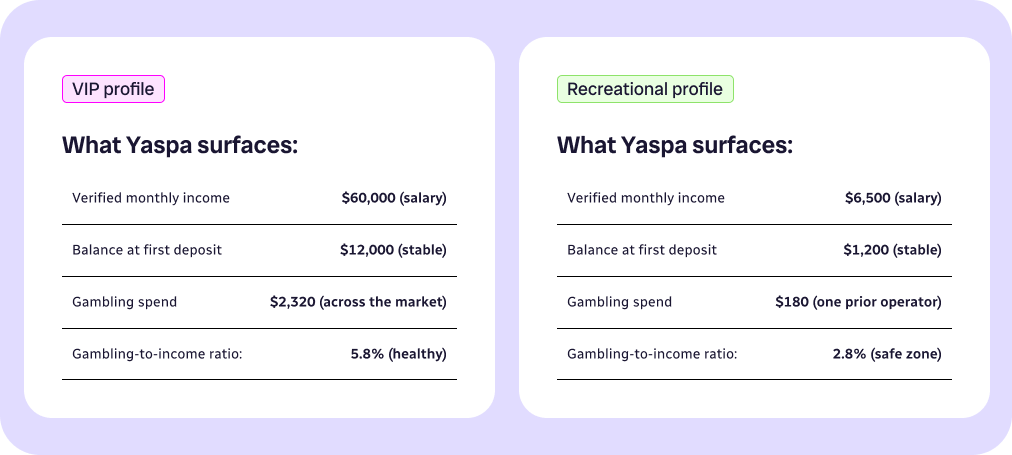
Same day, same funnel, two entirely different players. With a blanket program, you’d have treated them identically for weeks. With cohort insight on day zero, you can build a plan around each one instead—tailoring the bonus to grow share of wallet at a pace that’s sustainable, rather than guessing and hoping the Customer Lifetime Value (CLV) math works out later.
For your compliance team, none of this replaces your CRM or your bonus engine, and it doesn’t make decisions for you. It gives you a verified picture to make better ones with. You stop overpaying players who were never coming back, and you stop directing bonus spend toward at-risk players whose early behavior can look strikingly similar to a genuine VIP’s. You reinvest that budget in the VIPs actually worth keeping, and get a real-time affordability signal on every player in the base. The data comes from a single bank connection at the point of deposit, only ever with the player’s consent, and it’s yours alone. That connection works in real time in both directions: the payment settles and the verified insight lands with it, in the same moment. Every insight is built from a player’s own bank transactions, shared once with their consent, and visible only to the operator that player deposited with. Yaspa never shares a player’s data with other operators.
“Operators tell us the same thing every time: they know their VIPs are worth protecting, they just can’t see them soon enough to act. Intelligent Payments closes that gap. You’re not waiting on a hunch anymore, you’ve got a verified number on day zero.”—Justin Fears, Director – US Enterprise Sales, Yaspa
Your highest-value players aren’t found. They’re identified, and usually too slowly to matter. The data that would have told you who they were was sitting in a bank connection you already had, from the very first deposit.
If you’re heading to G2E Las Vegas or the EGR Power US Summit this fall, this is the conversation worth having. Talk to the Yaspa team to see Intelligent Payments in action.
See Intelligent Payments in action →
The scenarios and figures in this piece use example data representative of what Intelligent Payments can surface from a player’s bank transactions. All figures are illustrative and provided for indicative purposes only. They are not a forecast or guarantee of results, which depend on each operator’s own program, player base, and market. Bank data is accessed through open banking, only with the player’s consent, and is visible solely to the operator with whom the player has deposited.
Subscribe
Discover the latest payments news and events from Yaspa and the fintech world in our monthly newsletter.
"*" indicates required fields