Subscribe
Stay in the know
Discover the latest payments news and events from Yaspa and the fintech world in our monthly newsletter.

Gambling operators face a unique challenge. To support safer gambling initiatives, understand affordability and identify risk, they need a clear picture of a customer’s financial behaviour. Yet the transaction data available through open banking rarely arrives neatly categorised.
A bank statement may show payment amounts, dates and merchant descriptions, but it doesn’t automatically reveal the patterns that matter most. Understanding whether a customer is receiving regular income, gambling across multiple operators or showing signs of financial stress requires a much deeper level of analysis.
Yaspa’s Intelligent Payments platform helps operators gain insight into a customer’s financial behaviour as part of making a payment. In our previous blog on gambling affordability and financial risk assessments, we explored how open banking provides a powerful source of data for understanding affordability and risk, and how linking checks directly to the payment solves the long-standing challenge of obtaining customer consent.
But collecting the data is only the first step.
Having analysed more than 100 million financial transactions, we’ve developed AI and machine learning techniques that uncover behavioural signals hidden within payment data. One of those techniques is what we call financial spectroscopy — an approach that identifies patterns within transaction data and uses them to classify merchants and activities with a high degree of confidence.
While the underlying methodology can be applied across many industries, gambling provides one of the clearest examples of how behavioural analysis can reveal insights that aren’t immediately obvious from transaction descriptions alone.
Open banking provides the right data for understanding a consumer’s financial position, but at its most basic level, transaction data only shows what you’d see on a bank statement: payment amounts, descriptions, dates and the direction of the payment.
It won’t tell you explicitly whether a transaction relates to income, a mortgage payment or a gambling deposit. It won’t reveal whether income arrives weekly, monthly or irregularly. Nor will it identify the operator behind a gambling payment or indicate whether that operator is regulated.
Financial services does have a standard for categorisation: Merchant Category Codes (MCCs), defined by ISO 18245. When attached to a transaction, MCCs provide a clear category. However, they offer little additional context, and many transactions carry no MCC at all because these codes are optional data fields within open banking APIs and aren’t consistently provided by banks.
There’s another challenge. Companies appear, disappear, merge and rebrand over time. Any categorisation approach must be able to adapt and keep its understanding current.
Most categorisation services rely heavily on transaction descriptions and the flow of funds.
A transaction description might read:
Using regular expressions, natural language processing or even large language models (LLMs), it’s relatively straightforward to determine that these represent a physical supermarket, an online supermarket and a fuel purchase.
This works well for major brands. It becomes more difficult when dealing with lesser-known companies:
Here, the description provides almost no context, despite clearly identifying a company. Search for it online, and you might find a children’s nursery or a holiday park — or maybe “Play” implies it’s a casino. Description alone isn’t enough.
Yaspa has analysed more than 100 million financial transactions, using the resulting insights to build AI-powered categorisation models.
The process breaks down into three broad stages:
The third stage is where things become particularly interesting.
To explain it, let’s take a brief detour into physics.
Spectroscopy is the study of how matter absorbs or emits light across different wavelengths. Every substance produces a unique spectrum, and unknown materials can be identified by comparing their spectra against a library of known reference profiles.
Yaspa’s financial spectroscopy follows the same principle, except the spectrum is built from payments rather than light.
We take every payment made to a merchant, analyse the distribution of transaction amounts and compare that profile against patterns we’ve already identified. Just as physicists identify materials from light signatures, we identify merchants from behavioural signatures.
A spectrum is rarely a single clean line. More commonly, it’s a series of peaks sitting on top of background noise.
Transaction data behaves in much the same way.
When we plot every payment amount sent to a merchant, gambling operators often produce a distinctive signature that is rarely seen elsewhere. We’ve observed this pattern consistently across both the UK and Irish markets.
The reason is simple: players tend to deposit round amounts.
Deposits cluster heavily around values such as £10, £20, £50 and £100 because customers actively choose how much to deposit, rather than paying for items in a basket. The result is a series of pronounced peaks separated by relatively sparse gaps.
Debit and credit transactions often exhibit different distributions as well, reflecting the mechanisms that generate them. Taken together, these characteristics form a unique financial fingerprint.
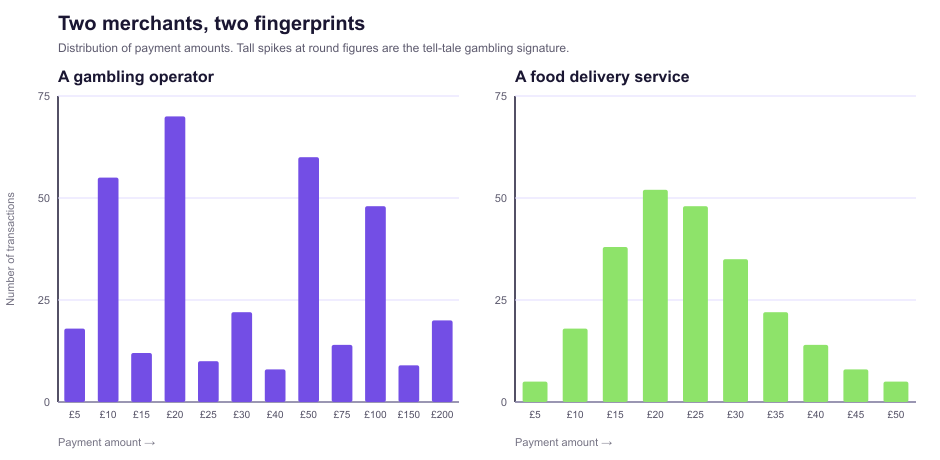
[Figure: Two merchants, two fingerprints] Distribution of payment amounts — tall spikes at round figures are the tell-tale gambling signature. Left, a gambling operator: pronounced peaks at £10, £20, £50 and £100. Right, a food delivery service: a smooth distribution clustered around a typical basket size.
Compare a gambling operator with a food delivery service.
A food delivery service typically produces a smooth distribution, with order values naturally clustering around a typical basket size. There are no pronounced spikes at round figures because customers are paying for specific purchases.
A gambling operator, by contrast, produces a far more fragmented pattern, dominated by deliberate round-number deposits.
Online retail, grocery shopping, child benefit payments and recurring household bills all generate their own distinct signatures — and none of them look like gambling.
Transaction amount is only one dimension of the analysis.
The same approach can be applied to time of day and day of month. Gambling activity often peaks during specific hours, such as early morning and evening periods, while displaying little predictable periodic structure.
Salary payments, utilities and mortgage transactions behave very differently. They tend to follow regular monthly patterns that are immediately visible when viewed over time.
Periodicity is its own form of spectrum. By combining transaction amounts, timing and recurring behavioural patterns, we can create a much richer picture than any individual signal could provide on its own.
Because these signatures are based on behaviour rather than transaction descriptions, they allow us to identify merchants whose activity resembles gambling even when nothing in the company name or category code suggests it.
The same principle applies beyond gambling. If a merchant’s behaviour matches a known pattern, it can often be categorised accurately regardless of how much information is available in the transaction description.
We combine this with longitudinal analysis, tracking known gambling consumers as they migrate between operators over time. This helps us identify merchants that warrant closer investigation.
Once a candidate merchant has been flagged, AI agents research it across publicly available sources to determine whether it is genuinely a gambling operator and, if so, establish additional details such as licensing status and operating jurisdictions.
At Yaspa, we know that open banking provides unprecedented visibility into consumer financial behaviour, but data alone isn’t enough.
The challenge lies in transforming millions of individual transactions into meaningful signals that can support better decisions.
By combining AI, machine learning and behavioural analysis, Yaspa’s Intelligent Payments helps gambling operators move beyond simple payment processing and towards a deeper understanding of affordability, risk and player behaviour.
That’s the difference between collecting data and generating insight.
Financial data contains far more information than is immediately visible on a bank statement. The challenge is turning that information into meaningful, actionable insight at the point of payment.
Want to learn how Yaspa’s Intelligent Payments combines open banking, AI and behavioural analysis to help operators better understand affordability, risk and player behaviour? Book a demo with our team.
Subscribe
Discover the latest payments news and events from Yaspa and the fintech world in our monthly newsletter.
"*" indicates required fields