

Subscribe
Stay in the know
Discover the latest payments news and events from Yaspa and the fintech world in our monthly newsletter.

Affiliate marketing is one of the biggest lines in many US operators’ acquisition budgets. It’s also one of the hardest to assess beyond cost and conversion. Depending on the state and the tax rate behind it, the cost per acquisition (CPA) committed per player can run from $200 to well past $600. And you’re committing that spend before you know whether the player was worth acquiring.
Your affiliate platform will tell you how many players each partner sent and what each one cost. What it won’t tell you is what kind of player each one is. Someone dropping $20 on their local team most Sundays looks identical, in click and conversion data, to someone who could comfortably stake ten times that. Deposit history sorts them out eventually, but that takes weeks—and in the meantime the same affiliate has sent hundreds more just like them, every one at full CPA. That’s the gap Yaspa’s Intelligent Payments closes, using consented transaction data captured at the point of deposit.
Two affiliates can look the same on paper. Same CPA. Same conversion rate.
But the players they deliver can look very different.
View the same two cohorts through the lens of Yaspa’s Intelligent Payments. The figures below are illustrative but representative of what Intelligent Payments can surface from consented bank data.
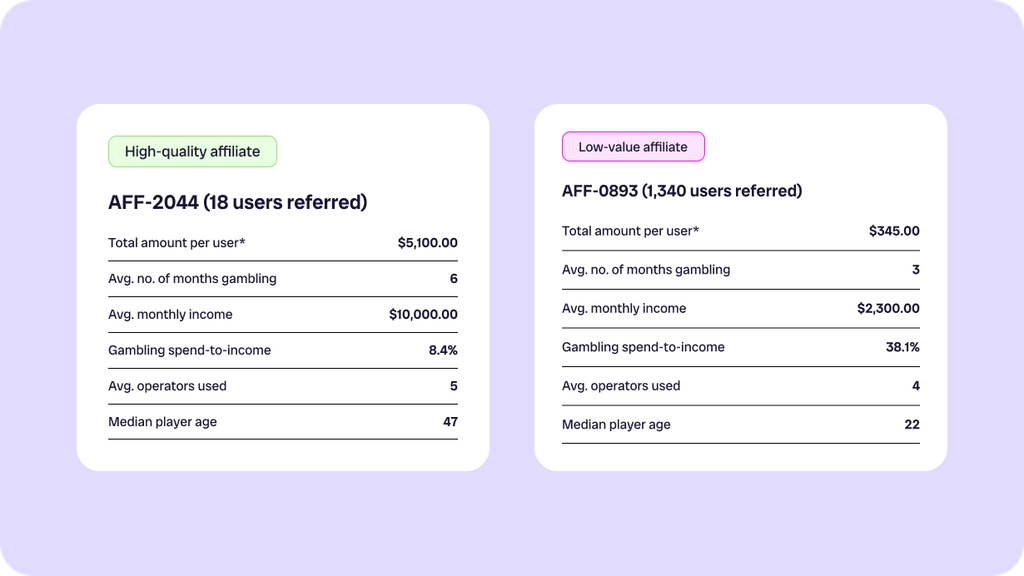
The high-quality affiliate is easy to overlook in standard reporting—just 18 players, nothing that stands out next to the volumes elsewhere. But look past the headline number: this is a financially stronger cohort, with experienced players, higher verified income and low gambling spend-to-income. Volume isn’t the whole story here. This is a cohort that could justify a higher CPA, or more of it.
The low-value affiliate tells the opposite story. On paper, 1,340 referred players looks like the affiliate to protect. But the cohort is younger, has lower verified income and barely any gambling history, with a much higher share of income going toward gambling. Bringing in the most players isn’t the same as bringing in the right ones—and on CPA and volume alone, this is exactly the affiliate a conventional report would reward.
Neither conclusion is available from click and conversion data alone. But transaction-derived insights can provide that additional context from the start of the player relationship.
Most operators already have two sources of data here: their affiliate platform and their CRM or BI reporting.
Affiliate platforms track clicks, conversions and CPA payouts by partner. They’re effective at measuring volume and cost, but they don’t tell you much about the financial profile of the players behind those numbers.
CRM and BI reporting adds behavior, deposits and engagement. It’s a step up from the affiliate platform—but it’s still reactive. It can take weeks or months of activity before the data says anything definitive, and even then, it’s telling you what a player did, not what they can do.
What’s missing is additional context such as verified income, gambling spend-to-income and pan-operator history, rolled up to affiliate level. That requires transaction-level account analysis, which Yaspa brings into the affiliate view.
It starts with data generated when a player deposits through Yaspa’s Pay by Bank payment flow.
With the player’s consent, Yaspa analyzes their transaction data in real time to identify signals including verified income, gambling spend-to-income and activity across operators. The analysis is embedded in the payment flow itself: no delay to the deposit, and no added friction for the player.
Attach the affiliate ID to the deposit, and every insight from that player is automatically credited to the affiliate who referred them.
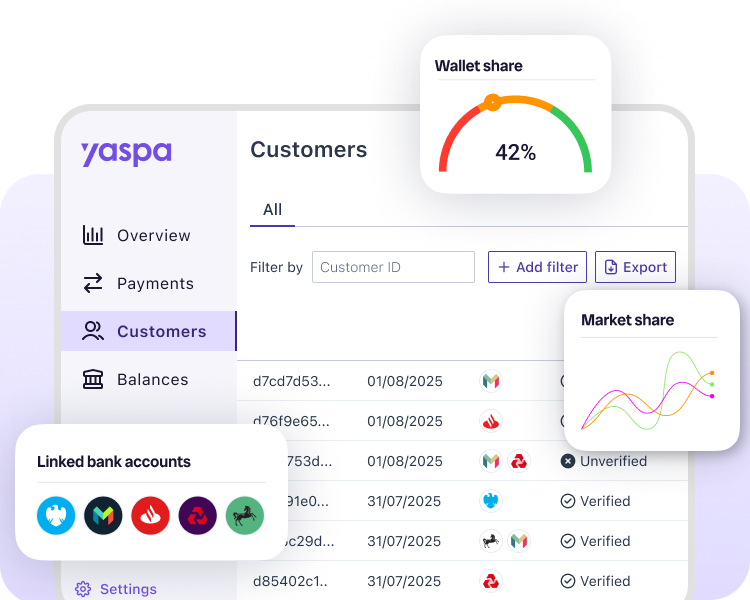
Instead of looking at players individually, those signals are rolled up by cohort. Compare affiliates side by side, then drill into an individual partner to understand the players behind the averages—in the Yaspa dashboard, or fed into the systems your team already works in.
For example, the Affiliate B cohort above is predominantly made up of 18 to 24-year-olds. The dashboard can also show how that cohort changes over time and let you explore income, gambling spend, transaction count and spend-to-income distribution.
“Every operator we talk to has the same blind spot. They can tell you to the dollar what an affiliate cost them, but very little about who that affiliate actually sent. By the time the revenue data gives them the answer, they could already be heading into another renewal. This gives the commercial team better evidence while there’s still time to use it.”
Justin Fears, Director, US Enterprise Sales, Yaspa
Your affiliate reporting tells you how many players converted and what they cost. Yaspa tells you whether they were worth it.
And when renewal season comes around, that’s valuable intelligence to have. Validate it against your own affiliates before the next contract is signed.
Book a meeting with one of our experts to see Intelligent Payments in action.
The scenarios and figures in this piece use example data representative of what Intelligent Payments can surface from a player’s bank transactions. All figures are illustrative and provided for indicative purposes only. They are not a forecast or guarantee of results, which depend on each operator’s own affiliate mix, player base and market. Bank data is accessed through open banking, only with the player’s consent, and is visible solely to the operator with whom the player has deposited.
Subscribe
Discover the latest payments news and events from Yaspa and the fintech world in our monthly newsletter.
"*" indicates required fields