
Subscribe
Stay in the know
Discover the latest payments news and events from Yaspa and the fintech world in our monthly newsletter.

The UK Gambling Commission has published new research on illegal gambling in Great Britain. The Commission’s earlier work on the illegal market drew on player surveys and estimated web traffic. This time it looked at actual payments, using anonymised open banking data that revealed money moving from British bank accounts to gambling operators, not all of which hold a UK gambling licence. The findings of this research therefore rest on what people really did with their money, not what they said they did.
The findings matter for how licensed operators understand their own players. The people using illegal operators in Great Britain are not a separate group. Most of them also gamble with licensed operators, and their illegal payments often sit close in time to their licensed ones.
The dataset came from YouGov. It covers 38,000 people who agreed to share their banking data for research, from July 2018 to July 2026. Of 157.2 million transactions, 4.8 million (3%) were with licensed non-lottery gambling operators. The Commission identified those licensed transactions using a gambling identification algorithm developed by Yaspa.
That algorithm is Yaspa’s transaction categoriser. Open banking supplies the raw data – an amount, a date, a description – but it doesn’t say what a payment is for, and the same company can appear on bank statements in many forms: a store number in one, a town name in another, a web address in a third. The categoriser uses machine learning to make sense of it. It first extracts the company names hidden in those descriptions, then merges the variants that refer to the same company, and finally classifies the company itself. It estimates how likely each transaction is to be with a gambling operator, and sorts every other payment into clear categories such as salary, groceries, utilities and loan repayments.
“We were happy to support the Gambling Commission with our transaction categorisation, and to share the approaches we use to make sense of financial data. Open banking data only becomes useful once you know what each payment is for, and that is exactly the problem our categoriser was built to solve.”
– Toby Sucharov, CTO, Yaspa
The models are built from more than 100 million transactions, with rules designed specifically for the gambling sector and a merchant database that keeps pace as brands launch, merge and rebrand. The same categorisation sits behind Yaspa’s Intelligent Payments, where it works in real time. More on this later.
For this research, the Commission labelled any transaction with a gambling probability above 50% as gambling. It says it believes it can identify the vast majority of licensed gambling transactions in its dataset – a level of coverage it’s careful to say doesn’t extend to the illegal market.
Finding the illegal transactions was harder. The Commission first searched transaction descriptions for the names of known illegal operators, and that failed. Its suggested explanation: illegal operators, unlike most legitimate businesses, may rarely or never include their name in the information they pass to payment providers.
Two further approaches worked. One matched exact descriptions from bank statements already known to involve illegal operators. The other matched merchant names strongly suspected of belonging to them. Together they found 3,426 transactions made by 179 people.
1. Players use both markets at the same time
Among people with repeated illegal transactions, 91% also gambled with licensed operators.
Their licensed activity didn’t fall away after their first detected illegal payment, either. In the six months before their first payment, they averaged between 23 and 29 transactions a month with licensed operators. In the six months after, it was between 19 and 25. Illegal transactions added 4.9 a month on average in the first month, then between one and two a month after that.
The illegal payments tended to arrive in clusters, often close in time to licensed ones. The Commission’s own reading is that illegal gambling sits inside existing gambling behaviour rather than replacing it.
2. Harm is concentrated in this group
Of the people with a detected illegal transaction and a Problem Gambling Severity Index (PGSI) score on file, 45% scored PGSI 8 or more. That’s the highest band on the index, the level used to indicate problem gambling (the lower bands are no risk at 0, low risk at 1 to 2 and moderate risk at 3 to 7). Among all licensed non-lottery gamblers in the same sample, the figure was 6%.
The Commission is careful about two limits here, and so are we. The sample is not nationally representative, so these figures only compare groups within it. And the study can’t show that using illegal operators causes harm. What it does show is that, in this sample, people with the highest harm scores were far more likely to be paying both licensed and illegal operators.
3. The money comes from current accounts
Almost all of the illegal transactions (96%) came from current accounts. Only 4% were made on credit cards, by 15 of the 179 people.
Licensed operators in Great Britain have been banned from accepting credit card payments for gambling since 14 April 2020 (Gambling Commission). That ban covers licensed operators, yet even with illegal operators, players paid from their current accounts almost every time.
Those are the same accounts a player connects when they deposit by open banking.
The Commission’s failed search by operator name points to a wider problem. Transaction descriptions are inconsistent, merchant category codes are optional in open banking data and often missing, and companies rebrand. Identifying a payment by its description only works when the description is complete.
Our CTO, Toby Sucharov, wrote about this problem in June. One of the techniques inside our categoriser is what he calls financial spectroscopy. It classifies merchants by how payments to them behave.
Gambling has a recognisable payment fingerprint. Players choose round deposit amounts, so payments cluster at £10, £20, £50 and £100, with gaps in between. The timing looks nothing like salaries, bills or shopping. A merchant whose payments behave like a gambling operator’s can be identified as one, even when its name gives nothing away. We then research flagged merchants across public sources to confirm whether they’re gambling operators and, if so, their licensing status and where they operate.
The Commission notes that its own method relies on knowing which operators to look for in advance. Classifying by behaviour doesn’t depend on a merchant’s name. No method sees everything, but behaviour tells you far more than a description alone.
The Commission is open about its limits. It can’t estimate the size of the illegal market. It only sees payments from accounts that support open banking, so cryptocurrency payments are missing. And it only catches transactions with a subset of illegal operators, some of which may no longer target the UK.
Even so, the evidence is clear. Gambling with illegal operators doesn’t happen somewhere else, among a different set of people. In this data, it ran alongside licensed gambling, through the same bank accounts, and often among the players who need the most care.
Licensed operators can’t control where else a player spends. They can make sure they have the full picture when it matters.
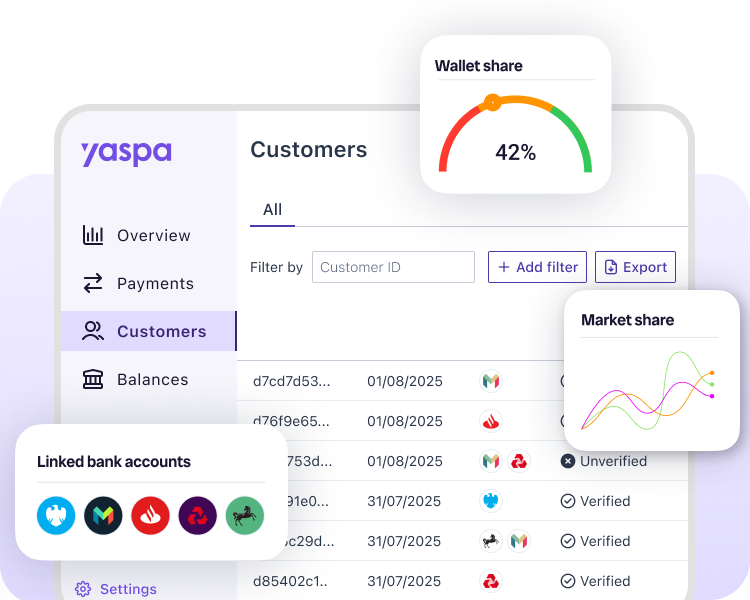
The Commission’s work gives us a broad perspective on UK gambling habits. This wider view is also available to operators, that until now have been restricted to visibility of deposits, withdrawals and play on their own platforms, through Yaspa’s Intelligent Payments.
The player deposits by bank transfer, the money arrives instantly, and withdrawals go back the same way. With the player’s consent at the point of deposit, the categoriser turns the same account data into a real-time view of:
There’s no document request and no separate check for the player to complete. For a player that’s active and apparently stable but spending in bursts elsewhere – that’s the difference between finding out early and finding out late, if at all.
Want to see what Intelligent Payments shows about the players behind your deposits? Book a demo with our team.
Source: Gambling Commission, Illegal gambling: findings from an open banking data analysis, published 28 October 2026.
Subscribe
Discover the latest payments news and events from Yaspa and the fintech world in our monthly newsletter.
"*" indicates required fields